Group Exhibition
Border Situations
LEAP – LEgAcy in Progress: (Re)Constructing European Narratives and (De)colonising Discoursesesented
- Dates
- 2026-04-07 — 2026-04-21
- Location
- Bunker Gallery · Budapest · Hungary
- Curator
- Johanna Liber
- Official website
- Visit exhibition website ↗

About the exhibition
Border Situations is the Budapest exhibition of the LEAP – LEgAcy in Progress: (Re)Constructing European Narratives and (De)colonising Discourses project. Starting from the historical memory of the transatlantic slave trade, the exhibition examines how colonialism continues to shape the present. Following Aníbal Quijano, it uses the term coloniality to refer to the afterlife of colonialism: the ways its effects persist in modern societies. The exhibition understands this as a logic that reproduces hierarchies by granting unequal access to protection, mobility, and recognition.
Exhibition statement
Participating artists
Sarah Diefallah, Róza El-Hassan, Anna Fabricius, Mansour Forouzesh, Zahra (Saba) Fuladvand, Anita Horváth, Dorottya Szonja Koltay, Norbert Oláh, Tímea Anita Oravecz, François Piquet, Regina Sárvári, Gypsy Criminals collective,
Hungary was not a classical colonial power, yet the exhibition argues that colonial modernity — that is, the continuation of relations inherited from colonialism — extends beyond the geography of former empires. Stereotypes tied to skin colour and origin continue to shape institutions, border regimes, labour relations, and everyday language. In this sense, inequalities produced by colonialism are also reproduced in Hungary, alongside internal colonisation and self-exonerating narratives of victimhood. Solidarity is therefore framed here as a practice that can be learned: not pity, but self-critique, risk-taking, and accountability. In François Piquet’s two-channel film, parallel monologues by Guadeloupean, white, and racialised (non-white) speakers make the possibility of allyship perceptible through the viewer’s own reactions.
Presented artwork
- Title
- The Capsule
- Series / collection
- (In)visible Meaning
- Date
- 2025
- Artwork page
- View artwork ↗
In recent years, in my documentary filmmaking practice, I have focused on the experiences of immigrants—those who leave their countries not for a temporary journey, but to build a life elsewhere. Through this ongoing research, I became interested in a fundamental distinction between traveling and migrating, a difference that is most clearly reflected in the contents of a suitcase.
A traveler’s suitcase typically contains practical and replaceable necessities: a toothbrush, a comb, and other everyday items. These objects serve immediate functions and can be acquired anywhere. In contrast, the suitcase of an immigrant carries something beyond utility.
It is not merely a container of belongings. Within it, alongside visible and functional items, there are objects that can be understood as extensions of the self—elements that metaphorically constitute part of one’s being. These objects are not essential for survival in a physical sense, yet they are crucial for enduring the condition of being away from home.
They exceed bureaucratic forms of identification. Rather than simply proving who someone is, they participate in shaping and maintaining that identity. Often small and materially insignificant, they carry a weight of memory, presence, and personal history that cannot be replaced or reproduced.
While a toothbrush can be purchased anywhere in the world, an object that holds an intimate connection to one’s past and sense of self cannot.
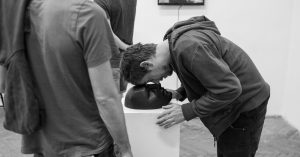
The Capsule installation emerges from this understanding. It focuses on objects that may appear ordinary, yet are irreducible in their meaning—items that carry an essential part of their owner’s identity. These objects embody something deeply human, shaping one’s being in subtle but significant ways. They carry an [IN]VISIBLE MEANING that exists between material presence and personal memory.
In this installation, I did not insist on specific objects, as I had initially encountered them during the process of my documentary work. Instead, I chose to place everyday items alongside traces of the human presence—suggestions of a hand, a leg, or a face that appear within the composition. Viewers are invited to imagine replacing these human elements with anything that matters to them—anything they would take if they had to leave their home without knowing whether they could ever return.
Inside the exhibition


Credits
Curators
- Johanna Liber Social media ↗
Organizers
- Pro Progressione Website ↗
Sponsors & supporters
- European Union
Additional credits
- Osvay Dorottya Ilona